

Overview: Streamlining a large-scale skills survey to increase responses and put the data to use
The Oji Group regularly conducted a skills survey to visualize the skills of each employee and use the results for placing the right people in the right roles and for talent development.
However, because the previous form tool limited the number of questions, the group had to split the survey across multiple forms, which confused respondents and made aggregation a burden.
The group therefore built a survey platform combining Kanal-WEB and kintone. By also connecting the BI tool Domo, it created a system that manages everything from collecting response data to aggregation and analysis in one place.
As a result, the number of responses roughly doubled compared with before. The accuracy of responses also improved, leading to a significant reduction in the time spent on aggregation.
Challenges: Scattered survey entry points burdened both respondents and administrators
Before introducing Kanal-WEB, the group used Microsoft Forms to conduct the skills survey.
However, because each form had a limit on the number of questions, the survey had to be divided by job type and department, eventually growing to 7–8 forms with more than 500 questions in total.
Respondents had to search for the forms they were supposed to answer, and the multiple entry points led to missed responses and a lower response count.
In addition, respondents entered their own employee numbers and names, so typing errors caused data mismatches. The collected responses had to be checked against employee records and corrected.
For a large-scale survey covering about 10,000 people, this checking took a great deal of time, and preparing the data for aggregation and analysis became a heavy burden.
Background: Low-cost operation even at a scale of about 10,000 people. Why the group chose Kanal-WEB
Kanal-WEB was introduced as the new survey platform to solve these challenges.
The group also considered other services, but the deciding factors were that Kanal-WEB could run a large survey of about 10,000 people at low cost and allowed highly flexible form building.
Solution: A single survey entry point with Kanal-WEB, and data utilization through integration with kintone and Domo
Instead of having respondents access multiple forms directly, the group switched to using Kanal-WEB as the common entry point for the survey.
The portal has a vertical menu that organizes the surveys by target category. It also clearly shows the outline and intended respondents of each survey, guiding respondents to the forms they need without confusion.
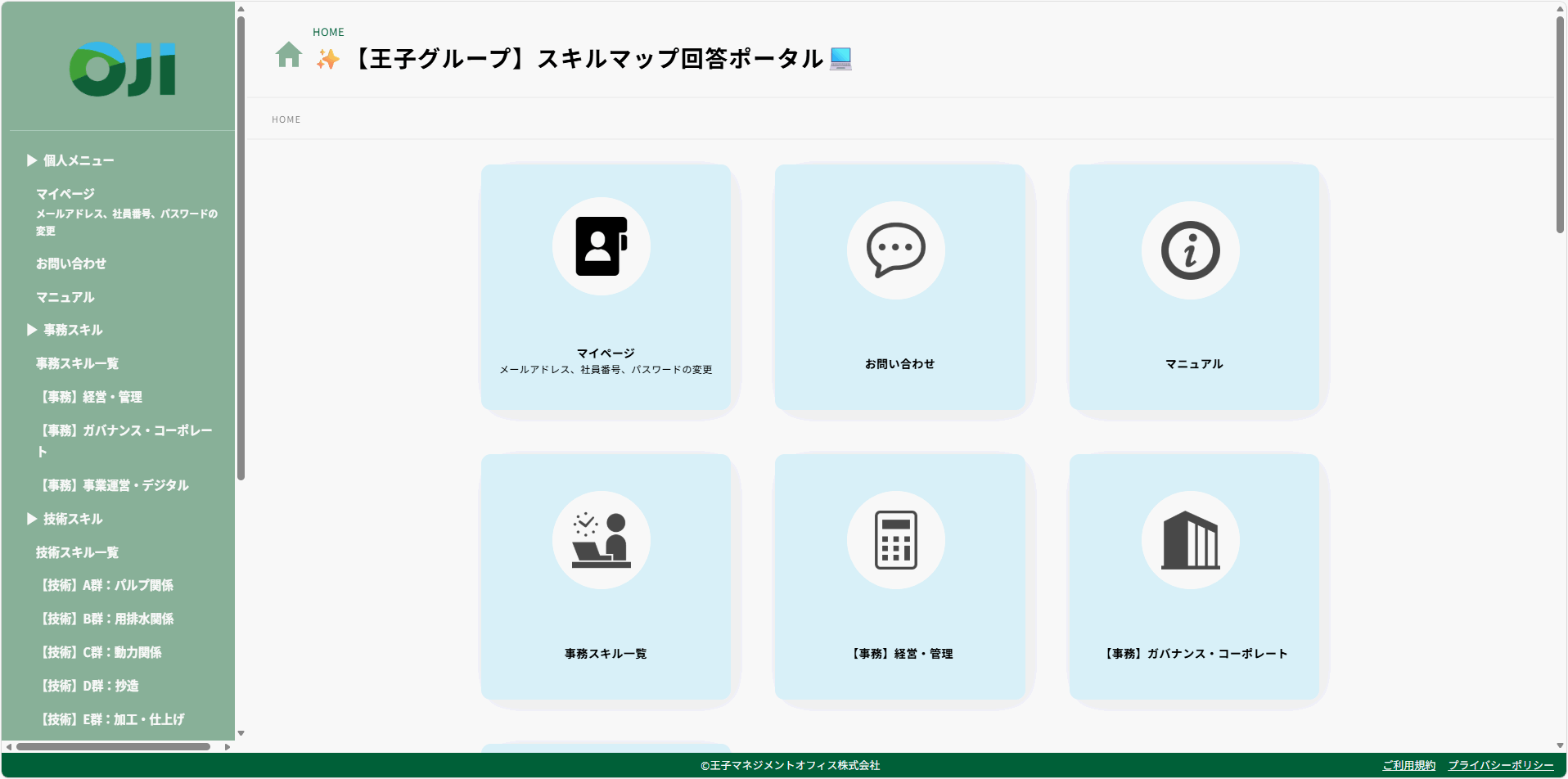
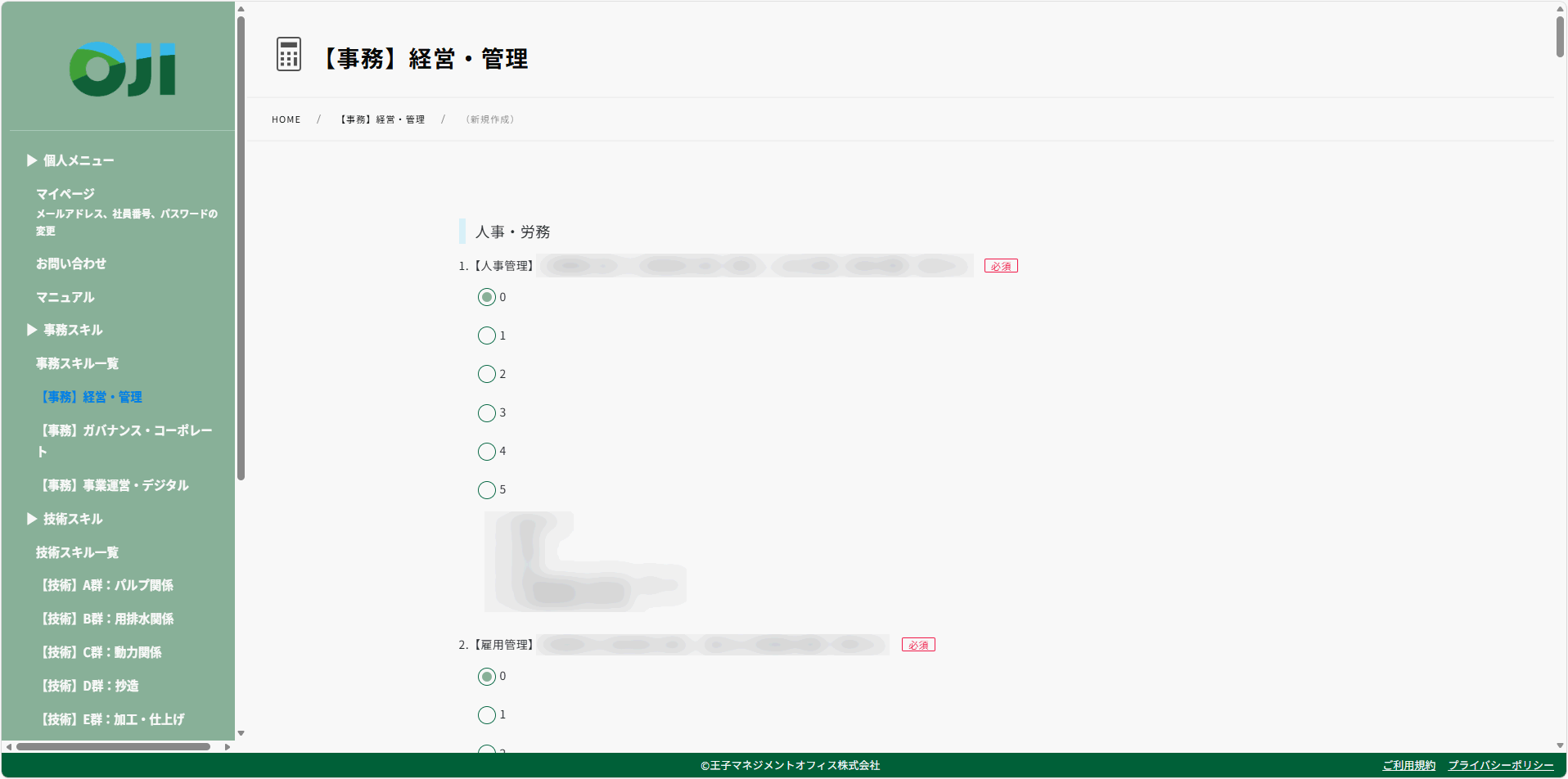
Response data is stored in kintone and automatically linked to the BI tool Domo.
The role of each system is as follows.
- Kanal-WEB: Survey portal and response screens for employees
- kintone: Storage and management of survey response data
- Domo: Aggregation, visualization, and analysis of response data
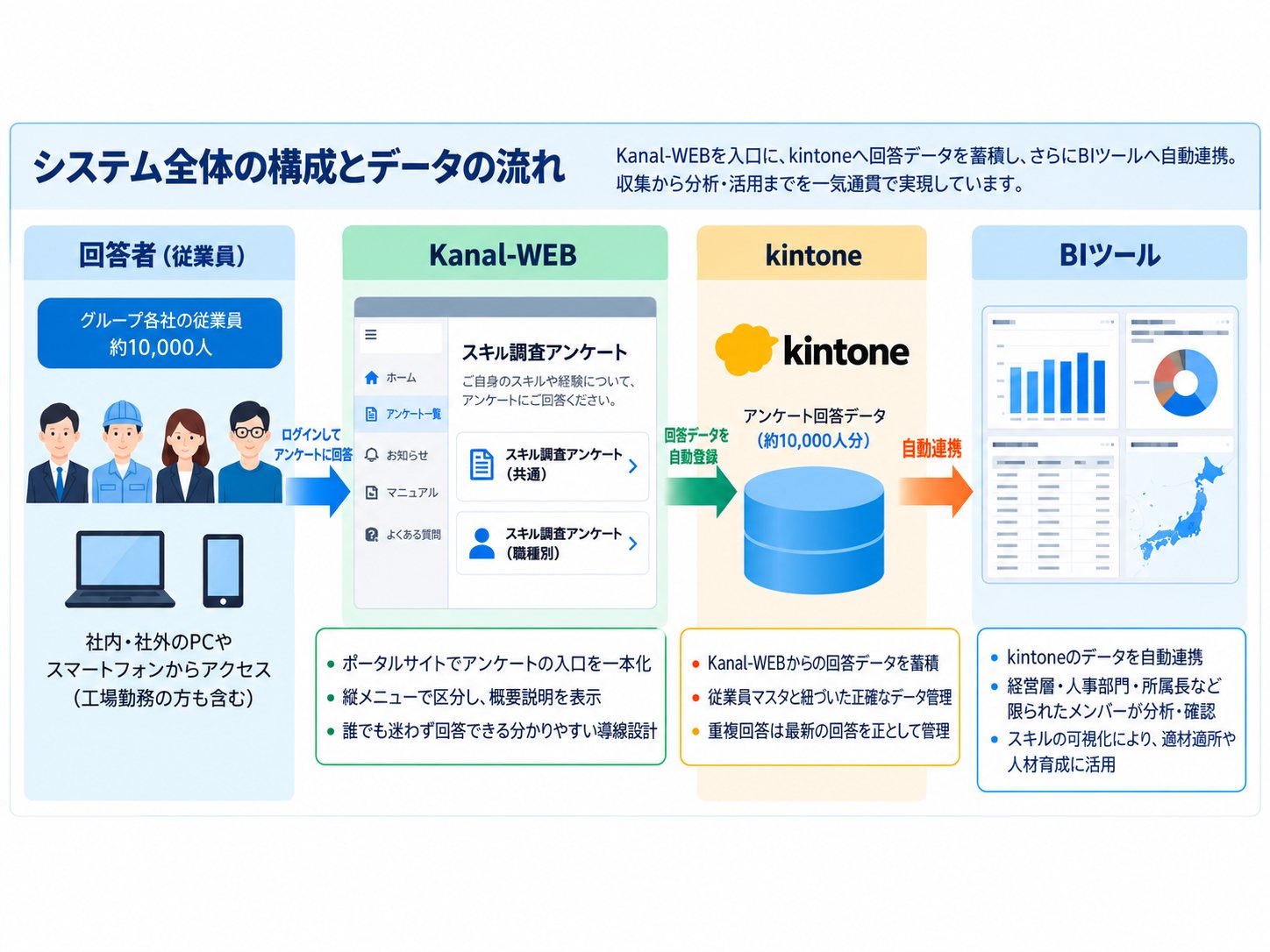
In Domo, only a limited group of people, such as executives, the HR department, and department heads, can view the results.
This makes it possible to manage the entire process, from answering the survey to collecting and analyzing the data, as one continuous flow.
Operational ideas: Making it easy for about 10,000 people to respond without confusion
To run the large-scale survey smoothly, the group put effort not only into building the system but also into informing respondents and managing response status.
The response period was set at about one month, and the survey was announced to respondents through the head of the HR department at each company. Reminders were sent to encourage responses.
The group also checked login status on the BI tool (Domo) dashboard to track progress.
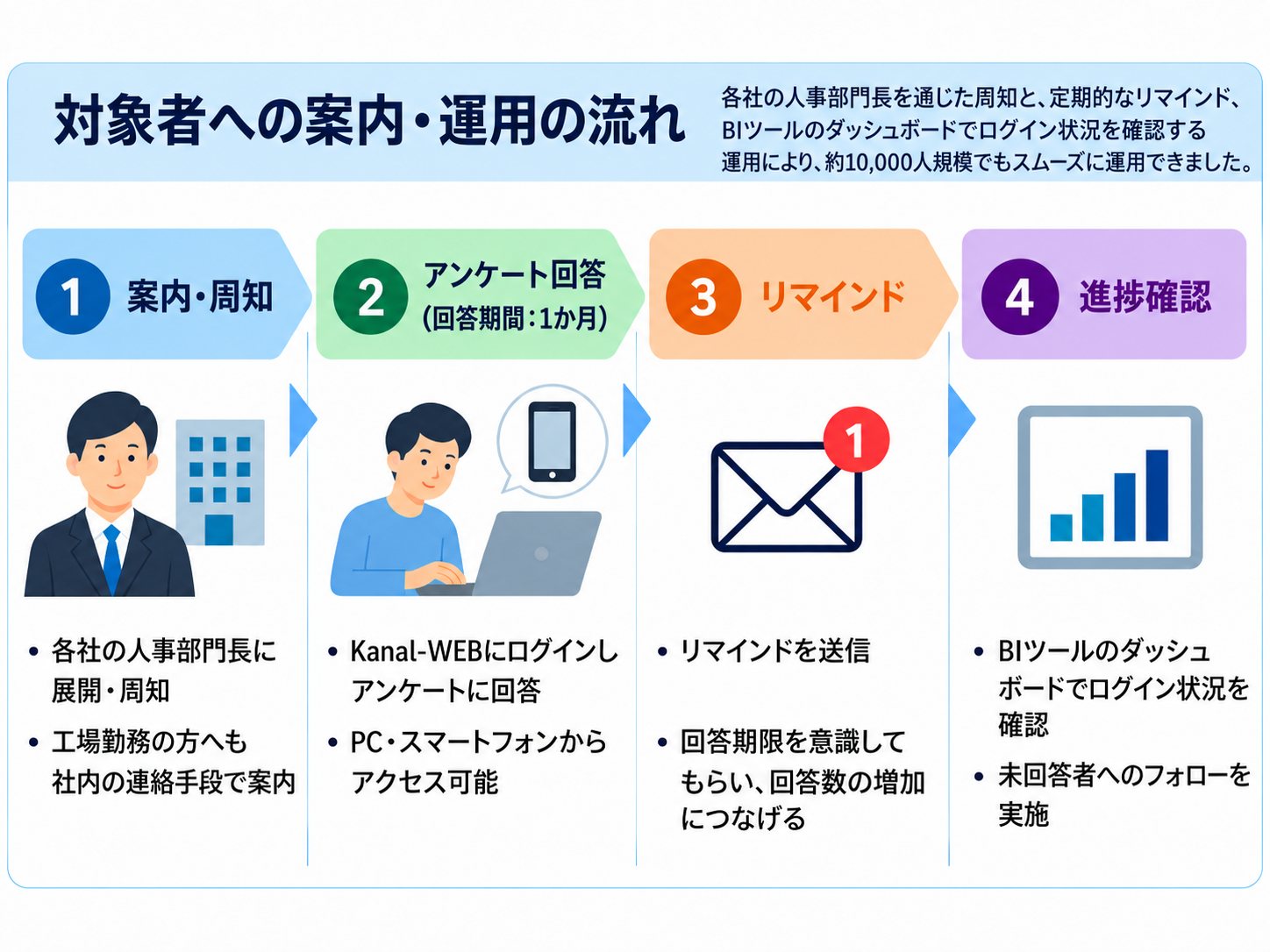
Because this survey also covered employees without a work email address, the way of informing them required some thought.
The group therefore launched a dedicated website for distributing login information, so that all of the roughly 10,000 respondents could check the information they needed to log in.
Kanal-WEB was used for answering the survey. Because it can be accessed from both PCs and smartphones, it easily accommodates employees working in different environments.
In addition, the group set a rule that the most recent response is valid in the case of duplicates, establishing an operation aimed at accurate data collection.
Results: Responses roughly doubled, accuracy improved, and the aggregation workload was greatly reduced
After introducing Kanal-WEB, the most notable result was the increase in the number of responses.
The number of responses roughly doubled compared with before, exceeding initial expectations.
The accuracy of responses also improved. The effort previously required to check employee numbers and names for typing errors against employee records decreased, greatly reducing the checking work before aggregation.
Because response data is stored in kintone and automatically linked to Domo, the work toward aggregation and analysis has also become more efficient.
Good results were also seen in terms of ease of use for respondents.
Although there were inquiries about obtaining initial passwords, there were almost no inquiries about operating the screens or proceeding through the survey after logging in to Kanal-WEB.
Even at a large scale of about 10,000 people, the easy-to-understand screen layout is considered to have led to smooth responses.
The group also appreciated that requests for additional questions during operation could be handled flexibly.
Support: Implementation support that went smoothly even though it was mainly online
Everything from the pre-introduction explanation to the meetings for building the system was conducted mainly online, but the explanations were easy to understand and preparations for implementation went smoothly.
During actual operation, an issue arose with the expiration of initial passwords, and reissuing them was sometimes necessary. What left an impression was the attitude of considering future feature improvements internally in response to such issues.
Next steps: Making further use of skill information and creating easier-to-use screens
Going forward, the group plans to further enhance the operation of its skill map while making use of the system it has built.
In particular, it is considering preparing a manual for respondents and improving the UI of the survey screens.
Because questions with many options can make the screen long vertically, improvements toward screens that are easier to read and answer are expected.